
Material Selection Guide for Expanded Metal Panel Fence

Specifying Expanded Metal Panel Fence installations requires a careful evaluation of framing metallurgy and protective layers. Project engineers and procurement leads must balance perimeter structural rigidity against long-term site exposure. Boundary longevity relies directly on how wire cores and steel pipe structures manage local mechanical loads. Material compatibility determines whether a containment line withstands physical impacts or degrades prematurely under heavy atmospheric moisture.
Installation efficiency also dictates material choices across extensive industrial boundaries and residential perimeters. Standardized configurations reduce on-site labor requirements while maintaining alignment over large land areas. Procurement documentation remains available from the supplier to verify baseline compliance for specific deployment scales. Evaluating these technical factors ensures that industrial and commercial boundaries meet required operational lifetimes.
Dual-Material Configuration for Structural Rigidity and Impact Resistance
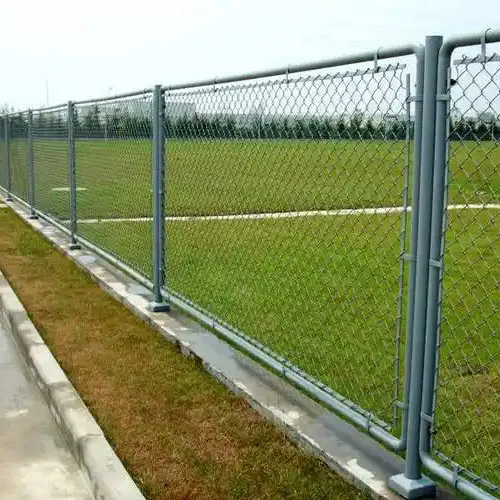
The combination of low carbon steel wire, galvanized wire, and steel pipe balances perimeter structural rigidity with impact resistance by distributing physical loads across distinct material zones. Steel pipe frameworks absorb linear tension and bending moments, while mesh elements constructed from low carbon and galvanized steel wire resist concentrated surface impacts without transferring localized stress across the entire boundary line.

Structural Interaction Between Wire Cores and Tubular Frameworks
Tubular steel posts provide the vertical and horizontal backbone required to resist wind-induced shear forces, while expanded wire elements maintain continuous containment integrity. Wire diameter variations and pipe wall thicknesses dictate the maximum deflection allowable before permanent structural set occurs.
Procurement teams evaluate wire gauge and tubing thickness against local wind velocity records during the initial design phase to prevent premature boundary deformation.
Operational Performance Across Industrial Parks and Residential Communities
Industrial parks demand high impact resistance from boundary fences to withstand heavy vehicle traffic and accidental collisions near loading zones. Residential communities prioritize visual integration alongside baseline intrusion deterrence, utilizing the same underlying wire and pipe matrix adapted for lighter physical duty cycles.
Pre-dimensioned components reduce field fabrication errors during large-scale deployment across diverse site conditions.
Technical file documentation is available from the supplier to verify baseline compliance for specific deployment scales and load ratings.
Matching Core Materials and Surface Protection to Environmental Exposure
Atmospheric corrosivity dictates the service life of baseline low carbon steel wire cores when protective layers degrade under persistent environmental exposure. Unprotected metal surfaces react rapidly with ambient moisture, causing oxidation rates to accelerate across industrial zones and marine boundaries.
Assessing Coating Performance Under Environmental Stress
Galvanized wire performance depends directly on zinc weight distribution and atmospheric exposure severity across specific project sites. Chemical pollutants in industrial parks interact with moisture to test barrier integrity, requiring careful evaluation against site-specific moisture levels.
Balancing Corrosion Resistance with Project Locations
Coastal installations and chemical processing perimeters demand thicker protective barriers than dry residential communities to prevent premature core degradation. Procurement teams must evaluate atmospheric exposure levels alongside local transport variables and purpose-port requirements before finalizing specifications.
Comparative Analysis of Material Configurations and Application Environments
Perimeter boundary selection requires mapping specific wire gauges, protective coatings, and tubular profiles directly to atmospheric corrosivity and mechanical stress profiles. Project planners evaluate whether baseline carbon wire needs heavy zinc coverage or if structural tubing requires supplemental finishes to prevent premature degradation.
Environmental exposure levels dictate protective coating thresholds across open-air sites. Uncoated configurations degrade rapidly in marine or chemically active zones unless paired with continuous galvanized protective layers that isolate the metallic core from moisture ingress. For highly corrosive atmospheres, project specifications must mandate verified barrier treatments.
| material | Application | Suitability for Humid Environments | Price Tier |
|---|---|---|---|
| Low carbon steel wire | construction site enclosures | Requires supplemental coating | Low |
| Galvanized wire | agricultural boundaries | Moderate to high resistance | Medium |
| Steel pipe | industrial parks | High structural longevity with coating | High |
Trade-offs between structural rigidity, impact resistance, and corrosion protection govern every deployment decision. While thick steel pipe frameworks deliver exceptional resistance against physical vehicle impacts, they introduce higher initial material acquisition costs compared to lighter mesh configurations. Balancing these physical factors ensures that perimeter boundaries maintain long-term stability without exceeding budgetary boundaries.
Evaluating Steel Pipe Frameworks for High-Security Wind and Impact Loads
Procurement specifications for high-security installations like airports and military bases require matching the steel pipe framework and mesh elements to site-specific wind and impact loads. Perimeter barriers surrounding critical zones must withstand severe environmental pressures without suffering catastrophic deformation or failure.
High-risk perimeter boundaries demand structural profile differentiation that standard commercial grades cannot provide. Tubular steel posts and heavy-gauge wire assemblies absorb concentrated physical force, depending on local wind speeds, geographic exposure, and potential vehicular collision risks.
When selecting structural profiles for military installations or aviation facilities, total weight allowances and transport logistics depend directly on the chosen steel pipe wall thickness and overall post spacing dimensions.
Optimizing Large Boundary Installations with Pre-Welded Modules
Standardized pre-welded module configurations significantly reduce on-site fabrication labor across extensive perimeter security deployments by eliminating field welding and complex alignment tasks.
Factory-assembled boundary segments arrive on site ready for immediate installation, translating directly to reduced heavy equipment rental durations and lower specialized contractor overhead. Project managers overseeing industrial parks or residential communities benefit from predictable daily installation rates, as factory tolerances remove the risk of cumulative dimensional drift during linear assembly.
Structural Alignment Control
Rigid factory jigs ensure uniform structural geometry, maintaining consistent post spacing and panel tension without manual field adjustments.
Linear boundaries maintain strict vertical plumb and horizontal level because every welded joint is set before delivery. This dimensional stability prevents gaps at connection points, preserving the integrity of the containment line against lateral displacement caused by environmental stress.
Operational Efficiency in Extensive Deployments
Deploying pre-fabricated modules accelerates project schedules, depending on site terrain preparation speed and local equipment availability.
Contractors manage labor allocation more effectively when material delivery aligns with pre-drilled footing schedules, avoiding bottlenecks common to manual fence construction. These efficiency gains lower total project expenses for commercial and industrial boundary installations where timeline compliance directly impacts capital expenditure budgets.
Site-Specific Application Mapping from Residential to Industrial Perimeters
Procurement planning across diverse deployment zones requires matching perimeter boundaries to specific operational risks. Residential communities and public parks depend on low carbon steel wire structures to maintain visual openness without sacrificing baseline containment. Industrial complexes and municipal infrastructure demand heavier framing configurations to withstand continuous daily operations and unauthorized access attempts.
Aligning Material Grades with Operational Demands
Agricultural perimeters and construction site enclosures experience varying levels of moisture exposure and mechanical wear. Galvanized wire mesh prevents premature atmospheric degradation when exposed to unpaved soils and seasonal precipitation cycles. Sports venues require enhanced impact dissipation across the lower boundary sections to absorb high-velocity equipment strikes during active events.
Project budgets determine whether initial deployments utilize standard galvanized wire or extended protective coatings. Sites located near coastal saltwater environments or heavy industrial emissions require higher zinc deposition rates to maintain structural integrity over multi-year operational windows.
Frequently Asked Questions
Baseline low carbon steel core performance depends heavily on coating coverage and local atmospheric corrosivity. Facility directors must match material selection and surface protection directly to environmental exposure levels, ensuring that coating longevity aligns with site-specific moisture and chemical conditions to prevent accelerated oxidation along the fence line.
Standardized pre-welded module configurations minimize on-site fabrication labor by eliminating extensive field cutting and welding. This modular pre-fabrication approach ensures uniform structural alignment across large boundary installations, significantly reducing installation time for project managers handling extensive perimeter security deployments.
Material selection depends on the operational demands of each buyer segment, ranging from residential garden fences to heavy industrial park boundaries. Buyers must align specific material grades and protective coatings with the mechanical impact frequency and visual integration requirements of the specific deployment site.
Deployment across construction site enclosures and farms depends on the required operational lifespan and relocation frequency. Buyers evaluate whether pre-welded modular units or standard galvanized wire configurations offer the best balance between initial material investment and reusability across temporary project phases.
Wire diameter variations and pipe wall thicknesses dictate the maximum deflection allowable before permanent structural set occurs under mechanical loads. Engineering teams assess these dimensions against expected physical impact levels, with exact performance limits depending on the selected tube wall thickness and span length.
Conclusion
Final procurement documentation depends directly on matching baseline component limits to designated deployment scales and import port destinations.
Project managers can review specific architectural requirements by evaluating regional wind loads and soil conditions against available low carbon steel wire and steel pipe inventories.
Technical verification files remain accessible through direct inquiry channels when establishing final purchase orders for extensive boundary projects.

Post time: Oct . 22, 2026 04:56